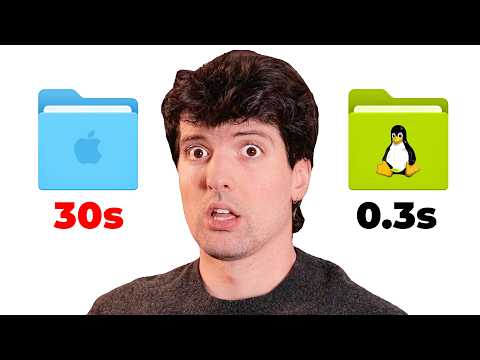
MacOS Is Making Your Mac Slow
Thursday, Aug 20 · 32 min · about 8 min to read
Theo-brain watched all 32 min
Theo found that AI coding agents feel slow on his Mac because of Apple's file system (APFS), not the hardware. Installs and work tree setup ran much faster on Linux. One install took almost 35 seconds on his Mac and under 10 on Linux. He now runs agent work on a separate Linux drive formatted as XFS with compression, which was fast and used far less space.
Skim itSkim it if you want Theo's reasoning in his own words, since the notes already cover what you need to act on.
Tap any time to jump the video there.
Key takeaways
The Mac's file system (APFS, the layer that tracks where files live on the drive) is the bottleneck for agent work. A pnpm install that only copied files already on the machine took almost 35 seconds on his Mac and under 10 on Linux.
35 seconds later, I've now finished my installs, which aren't even going over the network. By the way, all of those PNPM installs were hitting caches on this computer. It was just linking to existing files and folders on the machine. And somehow that took almost 35 seconds when on Linux it consistently
It is not the hardware. Theo says the Mac's drive is actually faster. In one benchmark, a Linux box throttled to 550 MHz ran installs at about the same speed as an M1 Max.
way more powerful then." Nope. Is drive faster? Absolutely not. The Mac drive is way faster. Is Linux's system just that
his Linux boxes to 550 megahertz and the resulting speeds were comparable to an M1 Max Apple chip. It was actually almost identical on the install speed. 550 megahertz throttle against an M1 Max chip and the results were similar speeds. That is terrible. This is very
You feel it every time an agent starts a task in a work tree (a separate copy of the repo so agents can work in parallel). That setup can take 100 seconds versus 10. On his own T3 Code repo it went from 10 to 12 seconds down to under two.
When I make a new thread in T3 code or codeex or quad or whatever and it does a work tree clone, this is the difference between that clone taking 100 seconds before it can start working and starting in 10 seconds. In real world use cases like mine with working on T3 code itself, the difference was about 10 to 12 seconds to under two seconds. Full
XFS with VDO compression saved a lot of space. Moving to it freed 44% of his storage. With 125 work trees installed, it used 24 GB, against 75 GB on standard Linux ext4 and 43 GB on the Mac.
the top level numbers. Switching to the XSVDL partition on my Linux machine resulted in 44% of my storage being saved. That is basically a 50% increase in my drive space for changing file systems. That's
Like 43 gigs versus 75.5. Like that's a meaningful decrease. But the VDO storage being 24 gigs. Yeah, a 3x decrease in the space being used for switching from ext4 to the XFS video setup. Pretty
Three skills here are new to you.
XFS + VDO/LZ4 compression for an agent drive New
- What it is
- Format a Linux drive as XFS with VDO underneath, a layer that compresses data before it hits the disk. LZ4 is the lightweight compressor that keeps reads and writes cheap. Duplicate files across work trees then take little real space.
- Why Theo cares
- His friend Wendell (Level1Techs) recommended it, and Theo's benchmarks confirmed it. Work trees and installs got fast, and it used about a third of the space ext4 did. He now runs all agent work on a separate drive formatted this way.
- How to try it
- Ask your agent to help format a spare drive on a Linux machine as XFS with VDO compression, separate from the OS drive.
- Keep the repos your agents work in on that drive.
- Time a pnpm install and a work tree creation before and after to confirm the gain.
a nearly immediate response from Wendell. Try XFS plus LZ4.
wrong. It flies. And now I do all of my agentic dev work on my Linux box on a drive separate from the OS drive that is formatted this way. And the results are
pnpm hard links: great on Linux, bad on Mac New
- What it is
- pnpm (a package installer) can use hard links, meaning many file names point to one stored copy instead of duplicating files. The effect depends heavily on the file system underneath.
- Why Theo cares
- On XFS it cut one delete-and-reinstall test from 7 seconds to 2.85. On the Mac, creating all those links pushed installs from about 40 seconds to about 100.
- How to try it
- On a Linux XFS setup, ask your agent to switch pnpm to hard links and re-time installs.
- Don't make that switch on a Mac expecting a speedup.
nuts. And the one performance gap that existed between EXT4 and XFS, which was the deletion and recreation one from the Novox bench, gets flattened immediately when you start using hard links for PNPM instead. It goes from 7 seconds to 2.85.
again, APFS does support links if you're willing to eat a huge overhead when you do it because now it went from taking 40 secondsish to 100 seconds when you're installing your node modules with hard links. insane because all of those links being created takes a ton of overhead on
Rift by Anomaly (for Mac users) New
- What it is
- An alternative to git work trees. It virtualizes the files so the agent sees a full copy, and it only writes new files when they change (copy-on-write). Theo says it makes work trees instant on macOS.
- Why Theo cares
- It is the one fix he points Mac users to. But he notes its last commit was two months ago, so it may be dead. He would rather use a better file system than hacks.
- How to try it
- If you must stay on Mac, look at Rift as a way to make agent work trees faster.
- Check its recent activity first, since Theo says it may no longer be maintained.
Rift is to be a better alternative to get work trees, especially on Mac OS. So, it virtualizes the files so that your agent can work on them and do real work as it would expect. and it doesn't actually persist the new files until you write to them again. Copy on write. The result is that it's instantaneous on Mac
continue to iterate on this. Actually, no, they haven't. Its last commit was 2 months ago and hasn't been touched since. So, this project might sadly be dead. But I am hopeful something like
Advice
Put an old computer at home to use. Install Linux on it, give it a file system like this, and run your agent work on it remotely through something like T3 Code or Claude's remote features.
running the stuff yourself. I do genuinely think every dev that's trying to maximize their use of these AI tools should have an old computer somewhere at their house that they can install Linux on, set up a file system like this, set up something like T3 Code or Claude's remote features or whatever to do their dev work on. The result will just feel
Skip ZFS and Btrfs for an agent coding box. Theo says both are much more intended for RAID (several drives storing copies of the same data), and his benchmarks ruled them out. He still uses Btrfs for his NAS and file storage.
extensible alternative. And then ZFS and Butterfs are both incredible, cool, often debated technologies, too, but I will say these are both much more intended for RAID. I knew they wouldn't
this is mostly meant to rule out APFS, ZFS, and Butterfs because it just doesn't really benefit to use those file systems for this. I still use both of those heavily, especially Butterf. I use it for all my NAS and like file storage stuff. Like
Hot takes
APFS is garbage for developers, to the point that Theo barely runs coding agents on his Mac anymore.
His reasoning: The trade-offs Apple's file system makes don't make sense for developers at all, and the performance is really bad.
where I link the nullbox bench. APFS is garbage to the point where I barely run code agents on my Mac anymore. Butterfs
negatives to most of them. But I will just say out right now, Apple's file system does not have compromises that make sense for us as developers really at all. The performance is really bad.
How Theo thought about this
Stock ext4 was already so much better than his Mac that he planned to stay on it. He feared compression would cost enough processor time to cancel out any speed gain. He tested it and found he was wrong: it flies.
single day. To be completely honest, ext4, just the stock Ubuntu install was already so much better than what I was used to with Mac OS that I wasn't planning on moving off. I was honestly
asked. I was concerned that the compression overhead for CPU would be great enough that it would cancel out any benefit for performance there. I was wrong. It flies. And now I do all of my
He took an expert's untested hunch and verified it himself. Wendell suggested XFS without benchmarks. Theo did a lot of benchmarking, confirmed it, and concluded that Wendell's advice can usually be followed blindly.
surprise, Wendell was right. He hadn't done any measurements or benching or anything to prove it yet. He just knew because he knows these things so well. And after a shitload of benchmarking on my end, I confirmed as usual that Wendell is right and you can usually just blindly follow his advice, which I
Sign in to mark what you've watched and keep notes.
Have a question about this one? Ask about this video →
Theo Daily is unofficial and not affiliated with Theo or t3.gg. Written by Claude Opus 5.5 from each video's transcript.